Came across this outrageous concept where the inventor, Behrokh Khoshnevis, proposes using this machine, similar in some ways to a 3-D printer, to "print" houses using cement. The company is called Contour Crafting. The process is well along in its development. I'm unclear whether full-scale, fully workable prototypes of the machine have been built but they have built some full-scale walls, etc. The claim is that a "house" could be built in 24 hours, with almost zero labour, while avoiding the +/- four tons of waste involved in construction of a conventional house... This is a little pie in the sky but probably not so far beyond plausibility as it might seem.
The website contains extensive information on potential applications, such as reconstruction following a Katrina style disaster. Quite mind-boggling to contemplate.
Proposed artistic applications include the creation of ceramic sculptures and the construction of houses in the Gaudi style.
Tuesday, January 23, 2007


Sunday, January 21, 2007
Reverse Graffiti Artists Moosing in on Advertisers
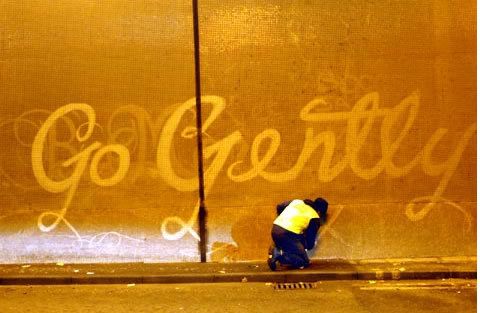
Here's a great item from Inhabitat via Grist.
A few innovative artists, including one Paul Curtis, otherwise known as Moose, have taken to creating graffiti by the novel approach of scrubbing grime off of exterior walls to leave an image in the clean part. (i.e. like "wash me!"). Some of the work has reportedly been paid advertising, which has included sponsors such as Smirnoff.
This has been occuring around the world in places from Sao Paulo to Leeds to L.A.
Surely this must be illegal, rants the city council and other busybodies in (you name the place). But what are they going to charge the artists with, cleaning without a licence? Hilarious!
Then there's a whole segment of commentators who immediately jump to the conclusion that this art is simply illegal advertising and should be dealt with accordingly. It is true enough but give me a break.
There is some validity to the idea that a building or business owner whose wall is hit by this type of "art" is a victim of vandalism likely involving illegal trespassing and who knows what else. But, if the image can be created just by using a brush and some elbow grease, then how hard could it possibly be for the owner to clean the rest of the wall? And, as far as that goes, if the grimy building and its impact on the cityscape is acceptable to the owner (and local busybodies) in the first place, what is the big deal about having a wall with an image on it, whatever the image is?
The important thing here is the idea. Apparently some of these artists may be in the process of being prosecuted. It would certainly be interesting to research and follow up these cases!
Tuesday, January 16, 2007
Condordia Undergrad Journal of Art History Arrives
The Concordia Undergraduate Journal of Art History that I ordered from Lulu arrived yesterday, January 15.
It was ordered online on a whim on New Year's Day, so the delivery time seems pretty reasonable.
As noted in the original post, there were two reasons for ordering such a thing as a Concordia Undergrad Lulu thingy. First was to enjoy the publication itself: The content, 13 essays filling 160 solid pages, promised diverse and thoughtful material. Without even looking at it, one could expect the work to be from a youthful, informed perspective that would be of interest to me and pertinent for this blog. Second was to investigate the whole idea of "instant" self publishing made possible by the "on demand" digital technologies offered by Lulu and other such companies.
I have looked into a couple of these, but so far have not seen anything nearly as flexible and appealing as the Lulu model.
The book I bought cost me only 7.95 us. All told, including shipping to the door it was $US15, with no apparent tax that I remember. Considering that I just paid $9.99 for a flimsy little copy of Charlotte's Web + gst + pst + driving somewhere to buy it, you can see that the Lulu price isn't too bad.
They offer many, many print related products produced from your original material. Several different formats of books are offered, many of which would be of interest for the visual artist or artists of many other types. As for the content of the book, I will leave that alone for now, rather than give a rushed synopsis of what little I have looked at so far.
The CU Art History Journal is a soft cover publication measuring approx. 8" x 8".
The only aspect where the look and feel of any commercial book doesn't come through is on the title page, or a couple of the inside front pages. Here, the type isn't quite laid out like in most books and a couple of things are missing, such as an "ISBN number" (which is available at Lulu for an extra charge) and certain other technical notes that we never read but somehow contribute to the feeling that most books have.
The binding is typical, indistinguishable from any commercial book you would find in a store. The cover is glossy and attractive, featuring a photograph by Erica Brisson, (who is also one of the authors) and printed in full colour. The inside layout is beautiful - very professionally done. The occasional graphics are smallish and included right on the pages amidst the text, but are very clear and serve their purpose. I found the space at the bottom of the page to be a smidgen more than seemed natural and the top was a tad crowded. Other than that - nirvana.
It was ordered online on a whim on New Year's Day, so the delivery time seems pretty reasonable.
As noted in the original post, there were two reasons for ordering such a thing as a Concordia Undergrad Lulu thingy. First was to enjoy the publication itself: The content, 13 essays filling 160 solid pages, promised diverse and thoughtful material. Without even looking at it, one could expect the work to be from a youthful, informed perspective that would be of interest to me and pertinent for this blog. Second was to investigate the whole idea of "instant" self publishing made possible by the "on demand" digital technologies offered by Lulu and other such companies.
I have looked into a couple of these, but so far have not seen anything nearly as flexible and appealing as the Lulu model.
The book I bought cost me only 7.95 us. All told, including shipping to the door it was $US15, with no apparent tax that I remember. Considering that I just paid $9.99 for a flimsy little copy of Charlotte's Web + gst + pst + driving somewhere to buy it, you can see that the Lulu price isn't too bad.
They offer many, many print related products produced from your original material. Several different formats of books are offered, many of which would be of interest for the visual artist or artists of many other types. As for the content of the book, I will leave that alone for now, rather than give a rushed synopsis of what little I have looked at so far.
The CU Art History Journal is a soft cover publication measuring approx. 8" x 8".
The only aspect where the look and feel of any commercial book doesn't come through is on the title page, or a couple of the inside front pages. Here, the type isn't quite laid out like in most books and a couple of things are missing, such as an "ISBN number" (which is available at Lulu for an extra charge) and certain other technical notes that we never read but somehow contribute to the feeling that most books have.
The binding is typical, indistinguishable from any commercial book you would find in a store. The cover is glossy and attractive, featuring a photograph by Erica Brisson, (who is also one of the authors) and printed in full colour. The inside layout is beautiful - very professionally done. The occasional graphics are smallish and included right on the pages amidst the text, but are very clear and serve their purpose. I found the space at the bottom of the page to be a smidgen more than seemed natural and the top was a tad crowded. Other than that - nirvana.
Saturday, January 13, 2007
Canadian Art / Business Initiative Goes Global
You may have heard about the company DNA 11 that is making a big splash in the media with its innovative (but not necessarily Earth-moving) personalized DNA portraits.
The Ottawa-based company was founded by Adrian Salamunovic and Nazim Ahmed
less than a year-and-a-half ago.
DNA 11 has had articles published about it all over the interrnet and across a huge spectrum of print and other media. They started their own blog just this past September but the media they have received has been phenomenal.
The success of this art business, at least in terms of media coverage, is a study in itself. DNA 11 has been covered in numerous decor mags, Fashion Television, the Discovery Channel, HGTV, Playboy, Wired, the Washington Post, Moco Loco, CBC Venture and tons of others, right on through to the New York Times Magazine a couple of weeks ago.
This, despite the fact that one might have thought it should only be a matter of time before someone came up with this concept. Around the world, the thousands of scientists who worked and continue to work on the genome project over the past ten years or so have included a large proportion of young graduate students whose circles of acquaintances must have included young, up-and-coming artists. DNA 11's concept should have been a no-brainer. After all, even the ultimate non-innovative artist , Thomas Kinkade, was already signing his prints with DNA-impregnated ink a few years ago.
One gets the sense that the mainstream national media world, ostensibly so difficult for artists to break into, is actually desperate for material that they can relate to.
Although some of the articles refer to the founders of DNA 11 as "artists," their website doesn't mention any particular artistic qualifications for either beyond an inclination towards "art appreciation." Only a handful of Canadian visual artists have succeeded in attracting mainstream international media attention over the past few years (well, any time, ever), and even though some purists might scoff at calling these portraits art, or put them rather in a category with commercial consumer fads, there is no doubt that visual artists can certainly learn from DNA 11.
After all, what is art if it does not involve interacting with an audience?
The Ottawa-based company was founded by Adrian Salamunovic and Nazim Ahmed
less than a year-and-a-half ago.
DNA 11 has had articles published about it all over the interrnet and across a huge spectrum of print and other media. They started their own blog just this past September but the media they have received has been phenomenal.
The success of this art business, at least in terms of media coverage, is a study in itself. DNA 11 has been covered in numerous decor mags, Fashion Television, the Discovery Channel, HGTV, Playboy, Wired, the Washington Post, Moco Loco, CBC Venture and tons of others, right on through to the New York Times Magazine a couple of weeks ago.
This, despite the fact that one might have thought it should only be a matter of time before someone came up with this concept. Around the world, the thousands of scientists who worked and continue to work on the genome project over the past ten years or so have included a large proportion of young graduate students whose circles of acquaintances must have included young, up-and-coming artists. DNA 11's concept should have been a no-brainer. After all, even the ultimate non-innovative artist , Thomas Kinkade, was already signing his prints with DNA-impregnated ink a few years ago.
One gets the sense that the mainstream national media world, ostensibly so difficult for artists to break into, is actually desperate for material that they can relate to.
Although some of the articles refer to the founders of DNA 11 as "artists," their website doesn't mention any particular artistic qualifications for either beyond an inclination towards "art appreciation." Only a handful of Canadian visual artists have succeeded in attracting mainstream international media attention over the past few years (well, any time, ever), and even though some purists might scoff at calling these portraits art, or put them rather in a category with commercial consumer fads, there is no doubt that visual artists can certainly learn from DNA 11.
After all, what is art if it does not involve interacting with an audience?
Monday, January 8, 2007
Artist CO2 Finds Snow, Makes Water
The artistic activity produced by the artist CO2 yesterday was successful in the objective of finding snow and making water.
The snow, however, was not the fluffy white sort you'd want to go for a romantic walk in and the water produced was definitely nothing you would want to drink, nor wash with, nor probably even wash your car with!
All in all, only two pretty pathetic excuses for snow were found. One area scouted was more like a mud-wrestling venue. The rest of the "alpine splendour" encountered was high and dry. Full report to follow.
The snow, however, was not the fluffy white sort you'd want to go for a romantic walk in and the water produced was definitely nothing you would want to drink, nor wash with, nor probably even wash your car with!
All in all, only two pretty pathetic excuses for snow were found. One area scouted was more like a mud-wrestling venue. The rest of the "alpine splendour" encountered was high and dry. Full report to follow.
Sunday, January 7, 2007
The Long March in Search of Snow
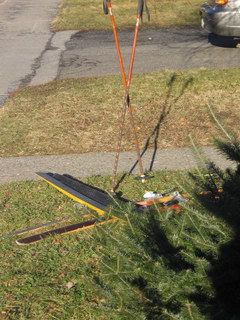
Montreal artist CO2 sets off today in search of the ever elusive snow.
The photo shows the state of affairs on this beautiful, albeit snowless day as the expedition begins.
Results will be published here later.
Saturday, January 6, 2007
Canadian Artist CO2 Journeys to the Mountains to "Make Water"
The Montreal artist CO2 will journey to the Mountains to find snow tomorrow, January 7, 2007 and, if successful in finding snow, hopes to "make water". The project is designed to draw attention to the problem of global warming.
Art White North will have a representative/photographer embedded in the CO2 entourage.
The weather in Montreal has been extremely warm all winter. Today, January 6, 2007, the high temperature in Montreal was 9.8 degrees C. The low temperature was 4.4 C. As a back-up plan, CO2 has placed a bid on GENUINE COLORADO BLIZZARD SNOW on eBay. The seller claims to pack the snow in dry ice so artist CO2 is hopeful that this will be a viable alternative.
After an extremely rare 100% green Christmas, there was a little snow in Montreal during Boxing Week and up until New Year's Day. Then, after a few warm, sunny and rainy days, there is little or no snow to be found in the Montreal area and definitely no clean snow. This is a very unusual state of affairs.
Further information will be published as available.
Art White North will have a representative/photographer embedded in the CO2 entourage.
The weather in Montreal has been extremely warm all winter. Today, January 6, 2007, the high temperature in Montreal was 9.8 degrees C. The low temperature was 4.4 C. As a back-up plan, CO2 has placed a bid on GENUINE COLORADO BLIZZARD SNOW on eBay. The seller claims to pack the snow in dry ice so artist CO2 is hopeful that this will be a viable alternative.
After an extremely rare 100% green Christmas, there was a little snow in Montreal during Boxing Week and up until New Year's Day. Then, after a few warm, sunny and rainy days, there is little or no snow to be found in the Montreal area and definitely no clean snow. This is a very unusual state of affairs.
Further information will be published as available.
Subscribe to:
Posts (Atom)